

Using Chemical Anchors
Key Takeaways:
- Chemical anchoring offers a stress-free alternative to mechanical anchors, ideal for sensitive or high-load applications.
- By adjusting anchoring depth, you can tailor load capacity for specific project requirements.
- Soudal’s SoudaFix delivers ETA-certified performance for concrete, masonry, and seismic installations and can be used in both cracked and uncracked concrete.
- Gorilla Bolt Fix provides a rapid-curing, low-odour solution that is pressure-free and ideal for securing threaded rods, reinforcement bars, profiles, and more. It performs in wet conditions, and in dry conditions it is suitable for use in uncracked concrete and masonry.
What is Chemical Anchoring?
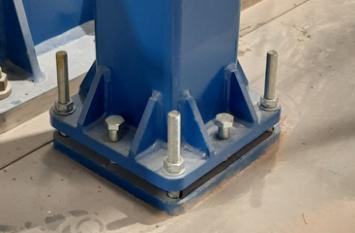
Chemical anchoring is a modern fixing method that enhances the load capacity, flexibility, and long-term durability of anchor points. Unlike mechanical anchors that expand within the drilled hole, chemical anchors use a two-part resin system to bond fixings directly to the substrate. This creates an exceptionally strong, uniform hold without placing stress on the surrounding material, making it ideal for use in sensitive or brittle substrates such as hollow brick, stone, or cracked concrete.
The technique allows for precise load control, as the anchoring depth can be adjusted to meet the structural demands of each project. This adaptability makes chemical anchors the preferred choice for high-performance and safety-critical installations, including structural reinforcements, heavy machinery fixings, and façade systems.
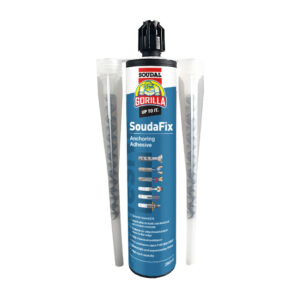
Soudal’s SoudaFix professional resin systems deliver versatile, ETA-certified performance across a wide range of materials, from uncracked and cracked concrete to solid and hollow masonry. SoudaFix is C1 rated for seismic applications, offering peace of mind where structural integrity is paramount.
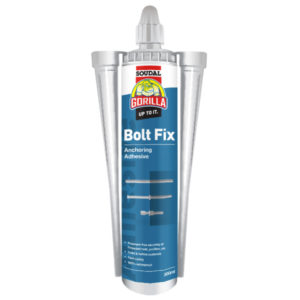
For fast, site-ready applications, Gorilla Bolt Fix Anchoring Adhesive provides a styrene-free, low-odour, two-component resin that cures rapidly, even in wet or low-temperature conditions. Its watertight, impermeable formulation ensures durable, pressure-free anchoring that’s 100% waterproof once cured. This makes it ideal for threaded rods, rebar, and profiles in both solid and hollow materials, delivering lasting reliability under diverse on-site conditions.
FAQs
What’s the main difference between mechanical and chemical anchors?
Mechanical anchors expand to grip the substrate, while chemical anchors bond via resin, eliminating surface stress and offering stronger, more flexible fixings.
Can chemical anchors be used in wet or cold conditions?
Yes, Gorilla Bolt Fix and SoudaFix are specially formulated for wet drill holes and low-temperature environments, maintaining full strength and durability.
Are SoudaFix products tested for structural use?
Absolutely. All SoudaFix products are ETA certified to a C1 classification, ensuring compliance with strict European performance and safety standards.
Do chemical anchors require special tools to apply?
They can be applied using standard cartridge guns or professional dispensing equipment, depending on the product format and job scale. Chemical anchor adhesives are supplied with specific ‘mixer’ nozzles for that product.